

Breathing vs. Burning: The Carbon Footprint Contrast
Breathing vs. Burning: The Carbon Footprint Contrast
Read the original archive edition (PDF)
Introduction
The human body, a marvel of biological engineering, produces carbon dioxide (CO2) as a natural byproduct of respiration. While essential for life, this CO2 emission often gets overshadowed by the staggering amounts of CO2 released through human activities, particularly the burning of fossil fuels. This article delves into the shades of these two sources of CO2, comparing their magnitudes and implications for our planet.
All living organisms contribute to atmospheric CO2 levels through respiration, a fundamental biological process. Respiration involves the breakdown of organic molecules (like glucose) to release energy, producing CO2 as a byproduct. Here's how different organisms contribute:
- Humans and Animals: Through cellular respiration, humans and animals inhale oxygen and exhale CO2. The amount of CO2 produced depends on metabolic activity, which is influenced by factors like physical activity, diet, and body size. On average, a human exhales about 1 kilogram of CO2 daily (Houghton, 2007).
- Plants: Plants contribute to atmospheric CO2 during respiration, particularly at night when photosynthesis ceases. However, plants act as net carbon sinks because they absorb more CO2 for photosynthesis than they emit (Raven et al., 2021).
- Microorganisms: Decomposers, such as fungi and bacteria, break down organic matter, releasing CO2. This process is vital for nutrient recycling in ecosystems but also adds to natural CO2 emissions (Schlesinger & Bernhardt, 2013).
- Oceans: Marine life, including plankton, contributes to the carbon cycle. While some marine organisms emit CO2, oceans also absorb significant amounts of CO2 from the atmosphere, acting as a natural buffer (Sabine et al., 2004).
Natural CO2 emissions from respiration and decomposition are immense, estimated at about 550 gigatons per year. However, these emissions are balanced by natural absorption processes, such as photosynthesis and oceanic uptake (IPCC, 2021). In contrast, human activities add approximately 36 gigatons of CO2 annually— seemingly small relative to natural emissions but entirely unbalanced, leading to a net increase in atmospheric CO2 concentrations (Friedlingstein et al., 2022).
CO2 from Breathing: A Drop in the Bucket
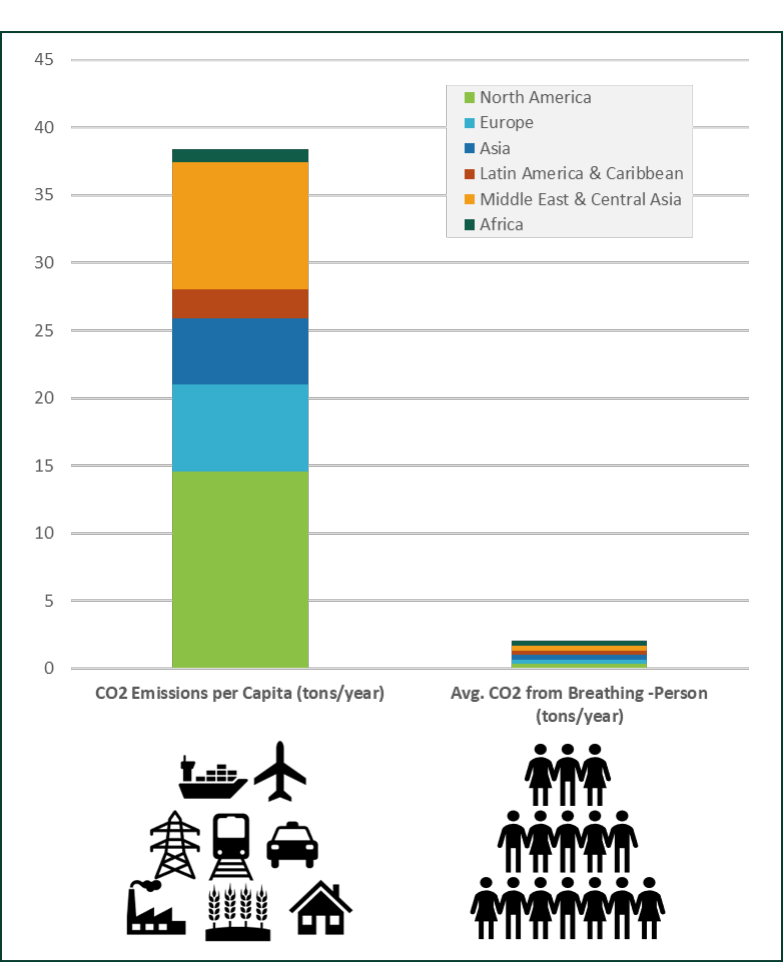
The average person exhales roughly 336 kilograms of CO2 annually (note that the average annual CO2 exhaled per person can range from approximately 190 kg to 450 kg, with a wider range due to various influencing factors), a considerable amount when viewed in isolation. However, this CO2 is part of the natural carbon cycle. The carbon we breathe out originates from the plants we consume, which, in turn, absorb CO2 from the atmosphere during photosynthesis. Thus, our respiratory CO2 is considered "carbon neutral" and doesn't contribute to the net increase of CO2 in the atmosphere.
Factors Influencing CO2 Exhaled:
Age: Children generally have lower CO2 emissions due to smaller lung capacity and lower metabolic rates compared to adults.
Exercise: Physical activity significantly increases CO2 production and exhalation due to higher energy demands and faster breathing rates.
Weather/Seasons: Hot weather can increase respiration rate, while cold weather might decrease it slightly.
Altitude: Higher altitudes have lower air pressure, leading to increased respiration rates to compensate for less oxygen per breath.
Individual Variations: Metabolism, body size, and overall health can influence CO2 production and exhalation rates.
CO2 from Human Activities: The Elephant in the Room
In contrast, the CO2 emitted through human activities, primarily the burning of fossil fuels for energy, transportation, and industrial processes, is the main driver of climate change. These activities release CO2 that was previously locked away for millions of years, disrupting the natural carbon cycle and leading to a rapid increase in atmospheric CO2 concentrations.
The disparity between CO2 emissions from breathing and human activities is evident when examining per capita emissions across different regions are shown in the above figure, which highlights that CO2 emissions from human activities overshadow those from breathing, especially in developed regions like North America and Europe.
Therefore, while individual actions like reducing our carbon footprint through lifestyle changes are important, addressing the climate crisis necessitates systemic shifts away from fossil fuels towards renewable energy sources and sustainable practices. The comparison between CO2 from breathing and human activities underscores the urgent need for global cooperation in mitigating anthropogenic emissions to safeguard our planet's future.
References:
- Boden, T. A., Marland, G., & Andres, R. J. (2017). Global, Regional, and National Fossil-Fuel CO2 Emissions. Carbon Dioxide Information Analysis Center. DOI: 10.3334/CDIAC/00001_V2017
- FAO. (2020). Global Forest Resources Assessment 2020. Food and Agriculture Organization of the United Nations. Retrieved from https://www.fao.org
- Friedlingstein, P., et al. (2022). Global Carbon Budget 2022. Earth System Science Data. DOI: 10.5194/essd-14-1917-2022
- Houghton, J. (2007). Global Warming: The Complete Briefing. Cambridge University Press.
- IPCC. (2021). Climate Change 2021: The Physical Science Basis. Intergovernmental Panel on Climate Change. DOI: 10.1017/9781009157896
- Keeling, C. D., et al. (2005). Atmospheric CO2 Records from Sites in the SIO Air Sampling Network. Carbon Dioxide Information Analysis Center. DOI: 10.3334/CDIAC/atg.035
- NOAA. (2023). Trends in Atmospheric Carbon Dioxide. National Oceanic and Atmospheric Administration. Retrieved from https://www.noaa.gov
- Raven, P. H., Evert, R. F., & Eichhorn, S. E. (2021). Biology of Plants (8th ed.). W. H. Freeman.
- Sabine, C. L., et al. (2004). The Oceanic Sink for Anthropogenic CO2. Science, 305(5682), 367–371. DOI: 10.1126/science.1097403
- Schlesinger, W. H., & Bernhardt, E. S. (2013). Biogeochemistry: An Analysis of Global Change. Academic Press.
- Smith, P., et al. (2014). Agriculture, Forestry and Other Land Use (AFOLU). In Climate Change 2014: Mitigation of Climate Change. Cambridge University Press.
- Our World in Data: CO₂ and Greenhouse Gas Emissions
- NRDC: Do We Exhale Carbon?
- GLOBE Scientists' Blog: Release of carbon dioxide by individual humans
- CBM Journal: The impact of human and livestock respiration on CO2 emissions from 14 global cities
Related Content
Sudan's Energy Balance 2020
Sudan’s energy balance for the year 2020 had shown lower figures from previous years trends, while maintaining largely the same proportions of energy supply resources,
Read Article →Scope 4 Emissions: The Concept of Avoided Emissions
In the global effort to combat climate change, the focus has traditionally been on reducing greenhouse gas (GHG) emissions from corporate operations and value chains.
Read Article →DPSIR Framework for Sustainable Aquaculture in the Red Sea Region (KSA): A Climate Adaptation and Mitigation Perspective
This paper is a contribution to the 6th International Workshop on Applied Research for Enhancing the Aquaculture Sector in Saudi Arabia.
Read Article →