

Supercritical Water Technology (SCWT) - A Sustainable Solution for Waste Management in Qatar
Supercritical Water Technology (SCWT) - A Sustainable Solution for Waste Management in Qatar
Read the original archive edition (PDF)
Introduction
Qatar’s rapid industrialization and urbanization have resulted in escalating waste generation, placing enormous stress on its existing waste management infrastructure. With limited land availability and the environmental hazards posed by traditional waste management methods such as incineration and landfilling, there is an urgent need for innovative and sustainable approaches. Supercritical Water Technology (SCWT) emerges as a transformative solution, capable of efficiently treating waste, recovering valuable resources, and aligning with Qatar’s vision for sustainable development under its National Vision 2030.
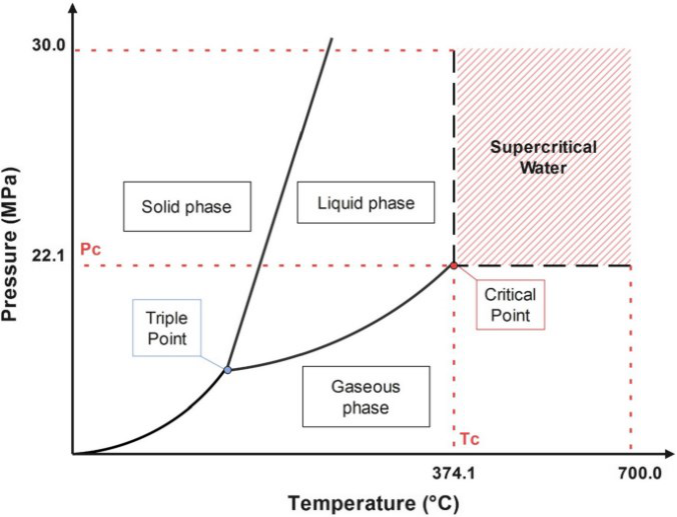
SCWT leverages advanced principles of thermal treatment, offering unparalleled efficacy in addressing a broad spectrum of waste management challenges. By integrating SCWT into its national strategy, Qatar can establish itself as a leader in environmental stewardship and circular economy practices.
SCWT Principles and Advantages
SCWT operates by exploiting the properties of water in its supercritical state, where it exhibits characteristics of both gas and liquid. Achieved at temperatures exceeding 374°C and pressures above 22.1 MPa, this state enables water to act as a powerful solvent and oxidant, breaking down organic waste into harmless byproducts such as water, carbon dioxide, and mineral salts.
One of the defining advantages of SCWT is its remarkable treatment efficiency. Unlike traditional waste treatment methods that often leave residual pollutants, SCWT ensures complete oxidation of even the most refractory organic compounds. This makes it highly effective for treating complex and hazardous waste streams, including industrial byproducts, medical waste, and municipal sludge.
In addition to its efficiency, SCWT minimizes waste generation by producing negligible sludge, reducing the volume of secondary waste that requires disposal. This makes it a cleaner alternative to conventional methods. Furthermore, the technology enables the recovery of valuable resources such as carbon dioxide, nutrients, and energy, turning waste into an economic asset while reducing the need for virgin materials.
SCWT also provides significant environmental benefits by drastically lowering greenhouse gas emissions and reducing reliance on landfills. By avoiding the harmful byproducts associated with incineration, such as dioxins and furans, SCWT ensures a cleaner and safer environment.
SCWT and Resource Recovery
One of the most compelling aspects of SCWT is its ability to recover valuable resources from waste streams, contributing to economic and environmental sustainability. For instance, the process generates high-purity carbon dioxide under high pressure, which can be repurposed for industrial applications such as the production of methanol, urea, and other value-added chemicals. This not only provides an avenue for reducing greenhouse gas emissions but also creates economic opportunities.
- CO2 capture and utilization: SCWT generates high-pressure pure CO2, which can be converted into value-added products like urea, methanol, and other chemicals.
- Nutrient recovery: Treating treated sewage effluent (TSE) can recover valuable nutrients like phosphorus and nitrogen for fertilizer production.
- Energy recovery: SCWT's high-temperature effluent can be utilized for generating electricity or preheating incoming waste streams through combined heat and power (CHP) systems.
SCWT also facilitates nutrient recovery, particularly from treated sewage effluent (TSE). By extracting essential elements such as phosphorus and nitrogen, the technology supports the production of fertilizers, which can be used in agriculture to enhance soil fertility. This aligns with Qatar’s goals of achieving greater resource efficiency and reducing its dependence on imported agricultural inputs. Energy recovery is another significant benefit of SCWT. The high-temperature effluent produced during the process can be harnessed for electricity generation or used to preheat incoming waste streams. By integrating combined heat and power (CHP) systems, SCWT can further enhance energy efficiency and contribute to Qatar’s renewable energy targets.
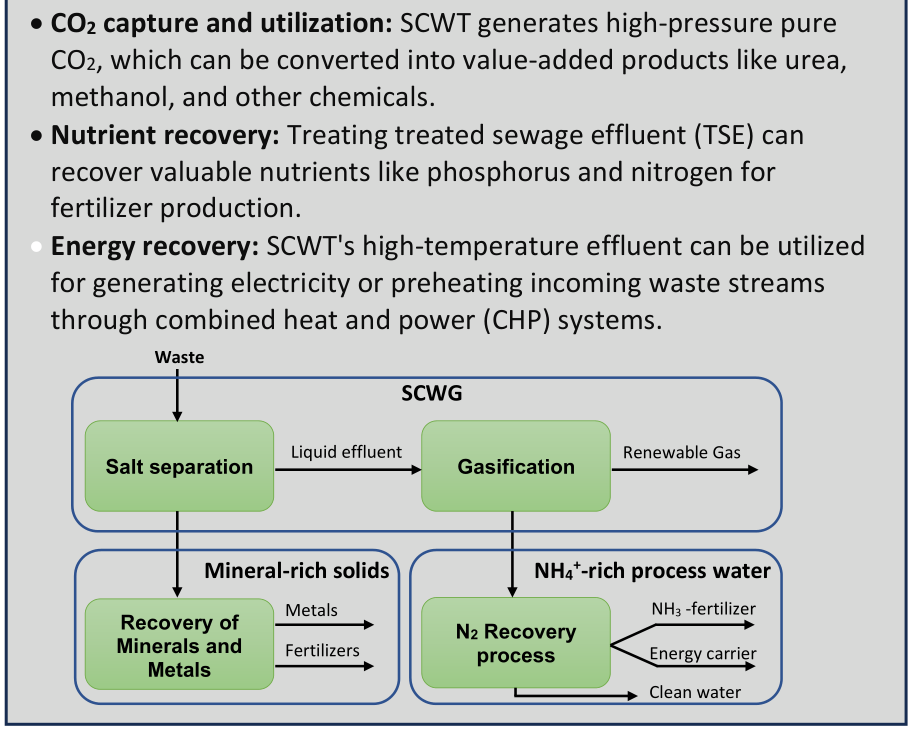
Read figure text
• CO2 capture and utilization: SCWT generates high-pressure pure CO2, which can be converted into value-added products like urea, methanol, and other chemicals. • Nutrient recovery: Treating treated sewage effluent (TSE) can recover valuable nutrients like phosphorus and nitrogen for fertilizer production. • Energy recovery: SCWT's high-temperature effluent can be utilized for generating electricity or preheating incoming waste streams through combined heat and power (CHP) systems. Salt separation Gasification Recovery of Minerals and Metals N2 Recovery process Liquid effluent Renewable Gas NH3 -fertilizer Energy carrier Clean water Fertilizers Metals Waste SCWG Mineral-rich solids NH4+-rich process water
SCWT and Circular Economy
SCWT is a vital enabler of Qatar’s transition to a circular economy, where waste is minimized, and resources are continuously repurposed. By converting waste into usable products, SCWT reduces landfill dependency and promotes sustainable resource utilization. For example, the technology ensures that treated wastewater can be safely reused in industrial and agricultural applications, closing the loop on water use.
This approach significantly reduces the need for virgin materials, as recovered nutrients and carbon dioxide can replace raw inputs in various industries. By fostering resource efficiency, SCWT contributes to a more sustainable and resilient economy, aligning with global best practices in circularity.
SCWT and Water Scarcity
Water scarcity is a critical challenge for Qatar, exacerbated by its arid climate and growing demand for freshwater resources. SCWT offers innovative solutions to address this issue by enabling the treatment and reuse of wastewater. For example, treated sewage effluent (TSE) processed through SCWT can be repurposed for industrial cooling, irrigation, or other non-potable applications, reducing pressure on Qatar’s freshwater reserves.
Additionally, SCWT enhances water conservation by enabling industries to reuse process water, lowering overall consumption. This dual benefit of water treatment and recovery makes SCWT a valuable tool in Qatar’s efforts to secure its water future.
SCWT vs. Traditional Waste Management
Compared to conventional waste management methods, SCWT offers numerous advantages that make it a superior choice for Qatar. Traditional approaches like landfilling and incineration often result in significant environmental degradation. Landfilling consumes vast amounts of land, which is a scarce resource in Qatar, and poses risks of soil and groundwater contamination. Incineration, on the other hand, releases harmful pollutants and greenhouse gases.
In contrast, SCWT eliminates these concerns by providing a clean and efficient alternative. The technology minimizes emissions, ensuring compliance with stringent environmental regulations. Additionally, SCWT’s ability to recover resources such as energy and nutrients not only offsets its operational costs but also contributes to long-term sustainability. By converting waste into valuable products, SCWT transforms waste management into an opportunity for economic growth.
SCWT Integration with Other Technologies
SCWT is most effective when integrated with existing waste management systems, creating a comprehensive and synergistic approach. For instance, SCWT can complement anaerobic digestion by treating the effluent generated during the process. This improves the quality of the treated output and enables the recovery of additional resources such as energy and nutrients.
Similarly, integrating SCWT with waste-to-energy (WtE) systems can enhance energy recovery by processing waste streams that are unsuitable for direct combustion. SCWT-treated water can also be reused in water treatment plants, supporting conservation efforts and reducing overall water demand.
Economic and Environmental Assessment
To ensure the successful implementation of SCWT in Qatar, a thorough economic and environmental assessment is essential. A cost-benefit analysis can evaluate the financial feasibility of the technology by comparing operational costs with the potential revenue from resource recovery. Life cycle assessment (LCA) can provide insights into the environmental impacts of SCWT, quantifying benefits such as reduced emissions and resource conservation. Additionally, market analysis can identify opportunities for commercializing recovered resources, further enhancing the technology’s economic appeal.
Policy and Public Engagement
The adoption of SCWT requires supportive policies and regulatory frameworks. Financial incentives, such as subsidies or tax credits, can encourage investment in SCWT infrastructure. Streamlined permitting processes and dedicated research and development funding can further accelerate implementation.
Public awareness campaigns are equally important to build trust and acceptance. Transparent communication about SCWT’s environmental and economic benefits can address concerns and foster collaboration among stakeholders.
Conclusion
Supercritical Water Technology (SCWT) offers a revolutionary approach to waste management, aligning seamlessly with Qatar’s sustainability objectives. By efficiently treating waste, recovering valuable resources, and reducing environmental impact, SCWT addresses critical challenges while contributing to a circular economy.
To unlock its full potential, Qatar must invest in research, pilot projects, and supportive policies. Stakeholders such as Ashghal can play a pivotal role in championing SCWT adoption, showcasing Qatar’s leadership in sustainable innovation. By embracing SCWT, Qatar can set a global benchmark for waste management excellence, fostering a cleaner, greener future.
References
- enerQA Consultancy, 2024. Concept Note on Supercritical Water Oxidation Technology for Sustainable Waste Management in Qatar. Available from: SCWO.pdf.
- U.S. Environmental Protection Agency, 2021. SCWO: A Promising Technology for Hazardous Waste Management. Available at: https://www.epa.gov/sites/default/files/2021-01/documents/pitt_research_brief_scwo_final_jan_25_2021_508.pdf.
- SpringerLink, 2021. Advances in Supercritical Water Oxidation Technology. Available at: https://link.springer.com/article/10.1007/s11157-021-09601-0.
- MDPI, 2023. Resource Recovery from Waste via SCWO Processes. Energies, [online] 16(4), p.2081. Available at: https://www.mdpi.com/1996-1073/16/4/2081.
- Semspub, 2021. Supercritical Water Oxidation for Effective Hazardous Waste Treatment. U.S. Environmental Protection Agency. Available at: https://semspub.epa.gov/work/06/9545963.pdf.
Related Content
Sudan's Energy Balance 2020
Sudan’s energy balance for the year 2020 had shown lower figures from previous years trends, while maintaining largely the same proportions of energy supply resources,
Read Article →Scope 4 Emissions: The Concept of Avoided Emissions
In the global effort to combat climate change, the focus has traditionally been on reducing greenhouse gas (GHG) emissions from corporate operations and value chains.
Read Article →The Imperative for ESG Readiness Tools: Unlocking Benefits for Companies, Institutions, and Society
Environmental, Social, and Governance (ESG) considerations have evolved from being a corporate trend to becoming essential criteria for sustainable and ethical growth.
Read Article →