

The Imperative for ESG Readiness Tools: Unlocking Benefits for Companies, Institutions, and Society
The Imperative for ESG Readiness Tools: Unlocking Benefits for Companies, Institutions, and Society
Read the original archive edition (PDF)
1. Introduction
Environmental, Social, and Governance (ESG) considerations have evolved from being a corporate trend to becoming essential criteria for sustainable and ethical growth. Across the globe, governments, companies, and institutions are increasingly aligning their operations with ESG principles to ensure compliance with global sustainability targets and the United Nations’ Sustainable Development Goals (SDGs).
In 2022, over 90% of the world’s largest companies published ESG reports (KPMG Survey of Sustainability Reporting 2022), yet less than 50% of SMEs globally had a clear ESG strategy. This gap underscores the need for readiness tools tailored to diverse organizational scales. On the other hand, ESG non-compliance increasingly translates to financial risks. The Global Sustainable Investment Alliance (GSIA) reported that $35.3 trillion, or about one-third of global assets under management, were in ESG-integrated investments by 2020. Companies failing to meet ESG criteria risk exclusion from these funds.
ESG readiness tools have emerged as critical instruments in this transition, enabling entities to systematically assess, report, and improve their ESG performance. In the Middle East and North Africa (MENA) region, these tools are proving to be not only transformative for businesses but also pivotal in addressing national priorities related to sustainability, governance, and societal well-being.
2. Do we need to report our ESG actions?
ESG reporting has become an indispensable tool for companies and institutions, enabling them to measure and communicate their performance in environmental, social, and governance domains. This transparency fosters trust among stakeholders, including investors, customers, and regulators, while aligning businesses with societal values. As global challenges like climate change and inequality intensify, ESG reporting helps organizations demonstrate their commitment to sustainability and ethical governance, fulfilling growing demands for accountability and responsibility. One of the primary benefits of ESG reporting is its ability to attract investment. Sustainable funds and investors prioritize ESG-compliant businesses, with global assets under ESG management exceeding $41 trillion in 2022. Additionally, it aids in risk management by identifying vulnerabilities in areas like climate impact, regulatory compliance, and social equity. By addressing these risks, companies not only safeguard their operations but also enhance their resilience and adaptability in a dynamic market landscape.
Beyond financial and operational advantages, ESG reporting plays a pivotal role in aligning organizations with global and national sustainability goals. It supports contributions to frameworks such as the United Nations’ Sustainable Development Goals (SDGs) and national climate strategies, enabling measurable progress toward clean energy, responsible production, and social equity. Furthermore, reporting drives innovation by identifying inefficiencies, encouraging resource optimization, and fostering the adoption of sustainable practices and technologies.
In a rapidly evolving regulatory environment, ESG reporting ensures compliance with local and international standards, mitigating legal and reputational risks. It also enhances long-term value creation by integrating sustainability into corporate strategies, benefiting not only businesses but also communities and ecosystems. As more companies embrace ESG reporting, it will serve as a cornerstone for global progress, ensuring a future that balances economic growth with environmental and social stewardship.
3. Why ESG Readiness Tools Are Essential
ESG readiness tools serve as structured frameworks that allow companies and institutions to evaluate their ESG performance and readiness systematically. These tools typically encompass:
- Assessment Criteria: Tools include detailed indicators across environmental, social, and governance dimensions, enabling organizations to benchmark their practices against global standards.
- Guidance and Strategy: They provide actionable insights for improvement, helping entities align operations with sustainability and governance expectations.
- Transparency and Accountability: By documenting practices, they foster trust among stakeholders, including investors, regulators, and communities.
4. The Role of ESG Readiness Tools in the MENA Region
The adoption of ESG frameworks in the MENA region has gained momentum in recent years. Countries such as Qatar, United Arab Emirates (UAE) and Saudi Arabia have introduced ambitious sustainability agendas aligned with their national visions. ESG reporting and readiness tools are playing an increasingly central role in translating these ambitions into actionable strategies for organizations.
Qatar, a major player in the global energy sector, has also embraced ESG principles. With its National Vision 2030 emphasizing sustainability, organizations in the country are increasingly turning to readiness tools to assess and improve their ESG standings. Companies like Qatar National Bank (QNB) have integrated ESG reporting into their operations, using structured tools to evaluate their carbon footprint and align their investments with green financing principles. These efforts not only contribute to Qatar’s national climate commitments but also enhance the global appeal of its corporate sector.
In the UAE, the Securities and Commodities Authority (SCA) mandated ESG disclosure for all listed companies starting in 2022. This regulation has encouraged firms to utilize readiness tools to align their operations with the requirements. Companies like Majid Al Futtaim, a leading retail and hospitality group, have adopted ESG reporting mechanisms, helping them enhance energy efficiency across their properties and align with the UAE’s Net Zero 2050 strategic initiative. Similarly, in Saudi Arabia, the Vision 2030 framework emphasizes sustainability and good governance as cornerstones of the Kingdom’s transformation. The Tadawul stock exchange introduced the ESG Disclosure Guidelines in 2021, compelling organizations to evaluate their environmental and social impact. The use of readiness tools in these contexts has enabled firms to identify gaps in compliance and develop targeted action plans.
4.1. Benefits for Organizations in the MENA Region
Organizations adopting ESG readiness tools in the MENA region are reaping significant benefits. For instance, compliance with ESG frameworks has proven to attract foreign investment. In 2021, the MENA region recorded a surge in sustainable financing, with green bonds and loans exceeding $18 billion, according to the Climate Bonds Initiative. Firms with robust ESG reporting mechanisms were at the forefront of these opportunities, as international investors increasingly prioritize ESG-compliant markets.
4.2. Benefits for Nations and Society
In the MENA region, where economies are heavily reliant on hydrocarbons, these tools are instrumental in supporting the transition to greener industries. For example, the UAE’s investments in renewable energy projects such as Masdar City demonstrate how ESG-aligned initiatives can catalyze economic growth while reducing dependency on fossil fuels. Similarly, Saudi Arabia’s $500 billion NEOM project integrates ESG principles to create a sustainable city powered entirely by renewable energy, showcasing how readiness tools can guide the implementation of visionary projects. The societal benefits of ESG adoption in the MENA region are equally profound. Improved corporate governance fosters trust in institutions, while environmental initiatives enhance public health by reducing pollution and promoting clean energy. Social criteria in ESG frameworks, such as gender diversity and labor rights, are driving positive change in workplaces, contributing to more equitable and inclusive societies. For instance, companies like Emaar Properties in the UAE have committed to enhancing genderdiversity within their leadership teams, a commitment driven by ESG evaluations.
4.3. The Future of ESG in the MENA Region
The widespread adoption of ESG tools and reporting in the MENA region is likely to accelerate progress toward achieving national and global sustainability goals. As more companies and institutions embrace these frameworks, the region can position itself as a leader in sustainable development. Predictive models suggest that by 2030, nations that adopt ESG principles extensively could see a 10-15% increase in foreign direct investment (FDI) as global markets increasingly prioritize ethical and sustainable practices. This trend is particularly relevant for the MENA region, where diversification away from oil-based economies is a pressing priority.
In addition, the adoption of ESG readiness tools can pave the way for regional cooperation on sustainability issues. Shared frameworks and standards will enable countries to collaborate on cross-border challenges such as water scarcity and climate resilience. For example, the GCC countries could use ESG readiness as a platform to develop unified policies on renewable energy and carbon trading, creating a competitive and sustainable regional market.
5. EnerQA’s ESG readiness tool
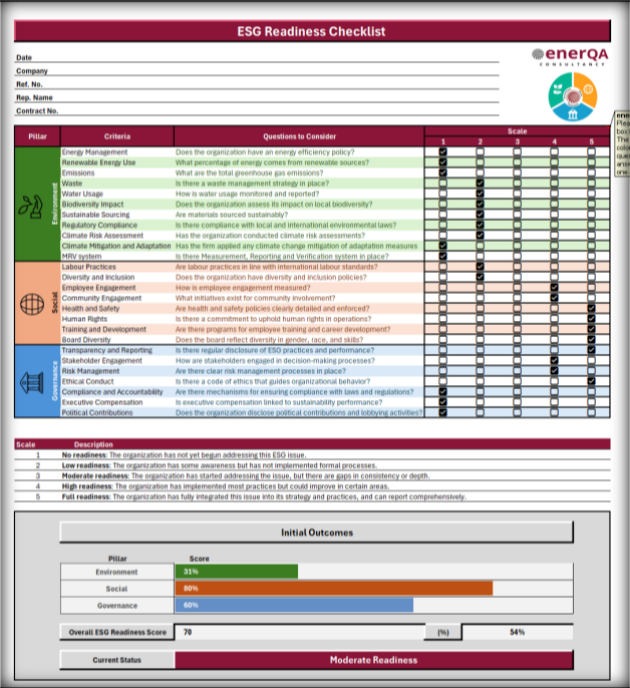
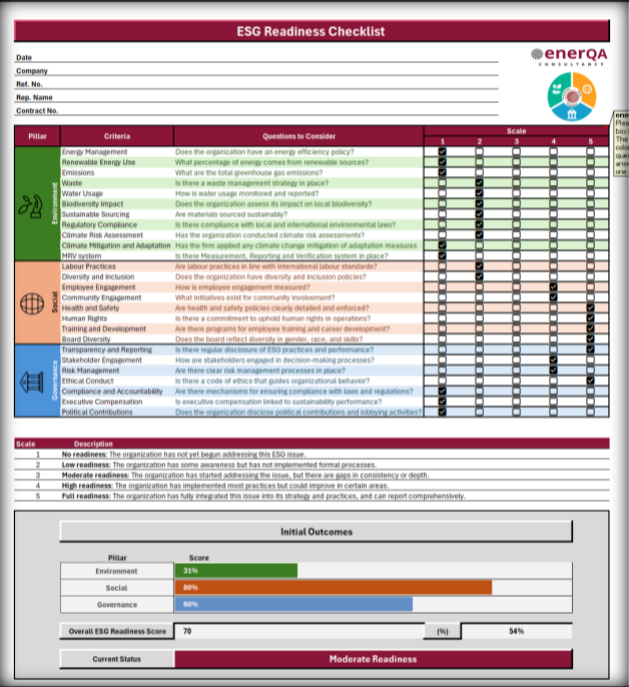
EnerQA has launched a free-to-download ESG Readiness Tool, designed on Microsoft Excel to provide an intuitive, user-friendly solution for assessing and improving ESG performance.
The tool simplifies the evaluation of Environmental, Social, and Governance pillars through structured criteria and guiding questions, allowing users to input their practices, score their readiness, and receive tailored recommendations for improvement.
The tool’s Excel format makes it accessible and customizable, enabling organizations of all sizes, especially SMEs, to adapt it to their specific needs without requiring additional software or expertise. By offering actionable insights based on scoring, it empowers users to address ESG gaps and align with sustainability and governance standards efficiently.
EnerQA’s tool is an ideal resource for companies aiming to enhance transparency, meet stakeholder expectations, and align with global goals. Download it now and take the first step toward measurable ESG excellence.
References:
- IBM Institute for Business Value. (2021). Sustainability at a Turning Point. Available at: https://www.ibm.com/thought-leadership/institute-business-value/report/sustainability
- Bloomberg Intelligence. (2022). ESG Assets May Hit $41 Trillion by 2022 but Not Without Challenges. Available at: https://www.bloomberg.com
- United Nations Sustainable Development Goals. (2015). Transforming our World: The 2030 Agenda for Sustainable Development. Available at: https://sdgs.un.org/2030agenda
- Harvard Business Review. (2020). The Financial Benefits of ESG Integration. Available at: https://hbr.org
- Climate Bonds Initiative. (2021). Green Bonds Market Report. Available at: https://www.climatebonds.net
- UAE Securities and Commodities Authority. (2022). Mandatory ESG Disclosure Guidelines. Available at: https://www.sca.gov.ae
- Saudi Tadawul Group. (2021). ESG Disclosure Guidelines. Available at: https://www.saudiexchange.sa
- United Nations Framework Convention on Climate Change (UNFCCC). (2015). Paris Agreement. Available at: https://unfccc.int/process-and-meetings/the-paris-agreement
- Climate Bonds Initiative, 2021 Green Bonds Market Report
- UAE Securities and Commodities Authority, ESG Disclosure Mandates
- Saudi Tadawul Group, ESG Disclosure Guidelines
- Qatar National Vision 2030, Sustainability Goals
- Harvard Business Review, The Financial Benefits of ESG Integration
Related Content
Sudan's Energy Balance 2020
Sudan’s energy balance for the year 2020 had shown lower figures from previous years trends, while maintaining largely the same proportions of energy supply resources,
Read Article →Scope 4 Emissions: The Concept of Avoided Emissions
In the global effort to combat climate change, the focus has traditionally been on reducing greenhouse gas (GHG) emissions from corporate operations and value chains.
Read Article →DPSIR Framework for Sustainable Aquaculture in the Red Sea Region (KSA): A Climate Adaptation and Mitigation Perspective
This paper is a contribution to the 6th International Workshop on Applied Research for Enhancing the Aquaculture Sector in Saudi Arabia.
Read Article →