

The Evolution of Climate Change Understanding and Response
The Evolution of Climate Change Understanding and Response
Read the original archive edition (PDF)
Abstract
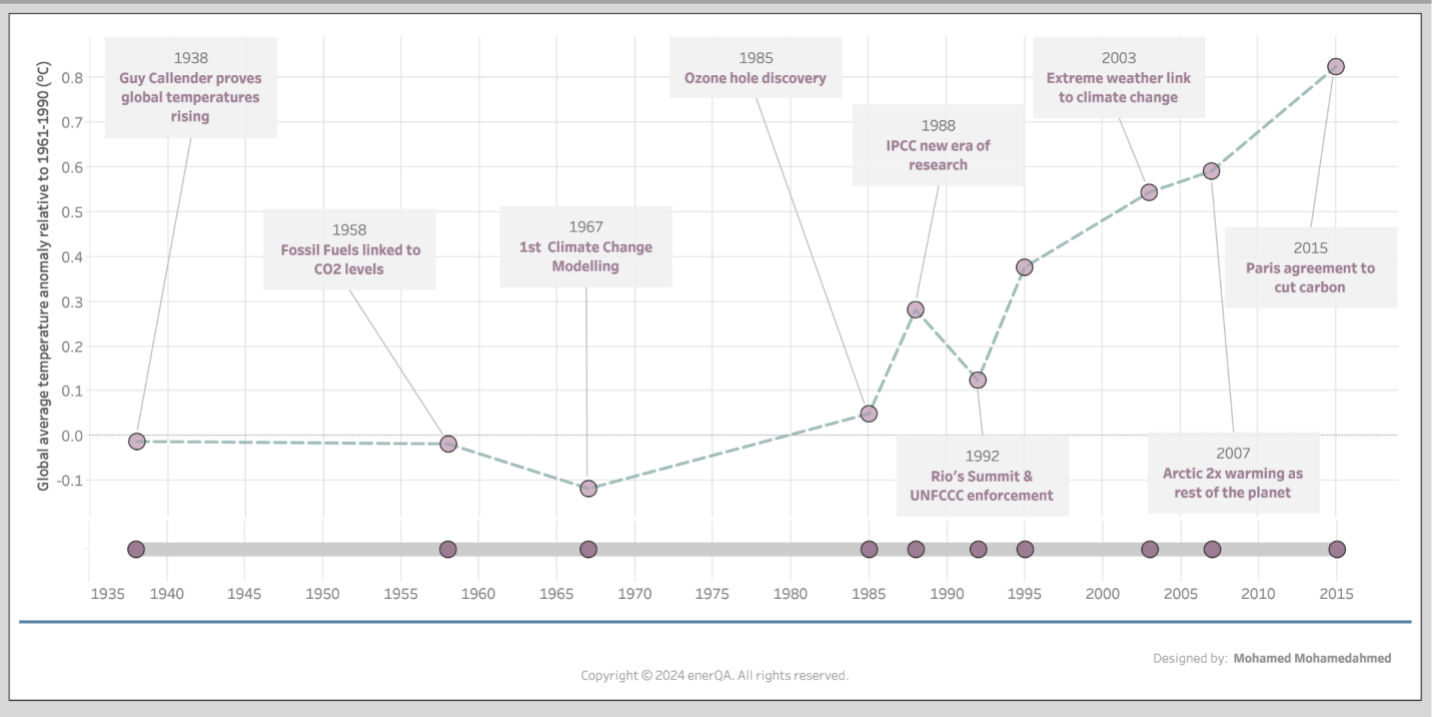
The field of climate science has undergone significant transformation over the past century, driven by pivotal discoveries, technological advancements, and international cooperation. This article traces the historical milestones in climate change research, policy development, and global temperature anomalies, emphasizing the interplay between science and policy. A key figure is provided to visualize global temperature anomalies relative to the 1961 – 1990 baseline and major events in climate change awareness.
Introduction
Climate change has progressed from an obscure scientific concept to a central focus of global policy. Beginning with early evidence of rising global temperatures, the scientific community has built a robust understanding of anthropogenic climate impacts. Simultaneously, policy frameworks have evolved, culminating in agreements like the Paris Accord, aiming to mitigate climate impacts and adapt to inevitable changes.
Historical Overview and Major Discoveries
The trajectory of climate change science is marked by key milestones:
- 1938: Guy Callender demonstrated rising global temperatures for the first time, setting the foundation for modern climate studies.
- 1958: Charles David Keeling's measurements linked fossil fuel combustion to rising atmospheric CO2 levels*.
- 1967: The first climate change modeling was conducted, revealing the potential magnitude of anthropogenic impacts.
- 1985: The discovery of the ozone hole highlighted the interaction between human activities and atmospheric chemistry.
- 1988: The establishment of the Intergovernmental Panel on Climate Change (IPCC) ushered in a new era of research and international collaboration.
Global Temperature Anomalies
Figure 1 illustrates global temperature anomalies from 1935 to 2015, highlighting major events in climate science. Anomalies are presented relative to the 1961–1990 baseline. Early 20th-century temperatures show minimal deviation, while late 20th and early 21st centuries exhibit sharp increases, particularly after 1990.
* Charles David Keeling, a geochemist at the Scripps Institution of Oceanography, pioneered the precise measurement of atmospheric CO₂ in the late 1950s. His work began with a simple question: could CO₂ levels in the atmosphere be accurately measured and tracked? This pursuit led him to develop groundbreaking methods for high-precision measurements using an infrared gas analyzer.
In 1958, Keeling established a measurement station at the Mauna Loa Observatory in Hawaii. This remote location, away from industrial pollution, was chosen to capture a baseline measurement of atmospheric CO₂. Initial readings were groundbreaking: they revealed an annual cycle of CO₂ levels fluctuating with plant growth in the Northern Hemisphere. Over time, the data revealed an unequivocal trend — CO₂ concentrations were steadily increasing.
The Role of Policy
Policy responses have mirrored scientific advancements:
- 1992: The United Nations Framework Convention on Climate Change (UNFCCC) provided a legal basis for global cooperation.
- 1995: The Kyoto Protocol and the first Conference of Parties (COP) in Berlin solidified commitments to reduce emissions.
- 2015: The Paris Agreement marked a turning point, uniting nations in efforts to cap global temperature rise to below 2°C.
In addition to other global actions, such as:
- Montreal Protocol
- Extreme weather preparedness
- Carbon pricing and emission trading schemes
- Net Zero Commitments
Challenges and Future Directions
Despite progress, challenges persist. Current trajectories suggest the need for more aggressive mitigation strategies to avoid catastrophic outcomes. Emphasis on adaptation, equity, and innovation will be vital for future climate resilience.
Economic and Political Resistance: Fossil fuel-dependent economies and industries often resist climate policies.
Equity Concerns: Balancing the responsibilities and capacities of developed and developing nations remains contentious.
Funding Gaps: Climate finance commitments often fall short of promised levels, hindering mitigation and adaptation efforts in vulnerable countries.
References:
- Intergovernmental Panel on Climate Change (IPCC). Climate Change: The IPCC Scientific Assessment. Cambridge University Press, 1990.
- UNFCCC. The United Nations Framework Convention on Climate Change. UN, 1992.
- Paris Agreement. Adopted Framework for Global Climate Mitigation. UNFCCC, 2015.
- Keeling, C. D. (1960). The Concentration and Isotopic Abundances of Carbon Dioxide in the Atmosphere. Tellus, 12(2), 200–203.
- Intergovernmental Panel on Climate Change (IPCC). (2001). Climate Change 2001: The Scientific Basis. Cambridge University Press.
Related Content
Sudan's Energy Balance 2020
Sudan’s energy balance for the year 2020 had shown lower figures from previous years trends, while maintaining largely the same proportions of energy supply resources,
Read Article →Scope 4 Emissions: The Concept of Avoided Emissions
In the global effort to combat climate change, the focus has traditionally been on reducing greenhouse gas (GHG) emissions from corporate operations and value chains.
Read Article →The Imperative for ESG Readiness Tools: Unlocking Benefits for Companies, Institutions, and Society
Environmental, Social, and Governance (ESG) considerations have evolved from being a corporate trend to becoming essential criteria for sustainable and ethical growth.
Read Article →