

The Hidden Costs of Your Burger and Pizza: What’s Really at Stake?
The Hidden Costs of Your Burger and Pizza: What’s Really at Stake?
Read the original archive edition (PDF)
Introduction
When we buy a burger or pizza, we assume the price reflects all associated costs. However, many costs, especially environmental ones, remain hidden from consumers. Food production impacts the planet through carbon emissions, water consumption, and pollution— costs not reflected in prices. These are known as externalities, which contribute to market failures and environmental challenges like the tragedy of the commons (Pigou, 1932). This article delves into the concept of externalities and their impact on food choices.
Understanding Externalities
An externality is a cost or benefit affecting those not directly involved in a transaction (Coase, 1960). For instance, the price of a burger includes production and profit costs, but not the pollution from cattle farming, the carbon emissions from transportation, or water use for feed crops. These are negative externalities, which harm society without being accounted for in pricing. On the other hand, positive externalities, such as cleaner air from tree planting, provide societal benefits without cost. Ignoring externalities results in distorted pricing, misinforming consumer choices (Hardin, 1968).
Internalizing Externalities: The Solution
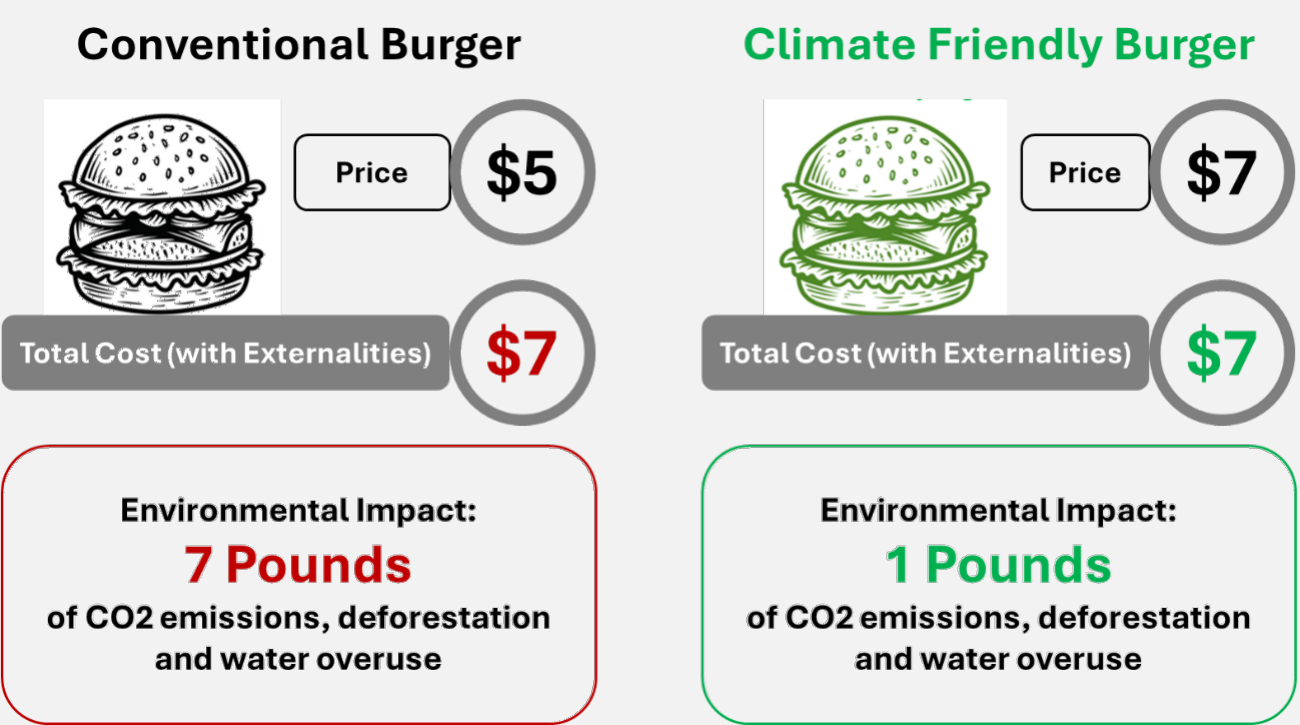
Internalizing externalities ensures goods' prices reflect true environmental and social costs. Governments achieve this through mechanisms like taxes and subsidies (Pigou, 1932). For example, a carbon tax increases the cost of high-emission products, while subsidies encourage sustainable practices like eco-friendly farming. If the environmental cost of a burger were included, its price might rise from $5 to $7, aligning with its true cost and encouraging sustainable choices (Nordhaus, 1994).
The Tragedy of the Commons
The tragedy of the commons describes how shared resources are depleted when individuals act in their immediate self-interest (Hardin, 1968). In food production, common resources like air, water, and land are exploited, leading to pollution, deforestation, and biodiversity loss. Overgrazing in shared fields, for instance, exemplifies this principle, demonstrating the need for regulation to prevent overexploitation.
Market Failure and Its Importance
Market failure occurs when prices fail to reflect true costs, leading to inefficient resource allocation. In conventional food production, unaccounted environmental costs keep prices low, promoting harmful consumption patterns. This exacerbates broader issues like climate change and soil degradation (Stiglitz, 2000).
Private Goods vs. Common Goods
While private goods like burgers or pizzas are individually consumed and paid for, the resources used to produce them— air, water, and fertile land— are common goods (Ostrom, 1990). These shared resources often face overuse and depletion due to a lack of accountability. Distinguishing between private and common goods is key to addressing market failures and promoting sustainable resource management.
Why Internalizing Externalities Matters
Correcting prices to reflect environmental costs addresses market failures. Products with high negative externalities become costlier, encouraging consumers to choose sustainable alternatives. This shift fosters responsible consumption, protects shared resources, and reduces environmental harm (Nordhaus, 1994).
Conclusion
Every choice between conventional and sustainable options impacts the environment. By internalizing hidden costs, market failures can be corrected, avoiding the tragedy of the commons and fostering a sustainable future. Spending a little more today on eco-friendly alternatives, like plant-based burgers or pizzas, contributes to a healthier planet tomorrow.
References
- Coase, R. H. (1960). The Problem of Social Cost. The Journal of Law and Economics, 3, 1-44.
- Hardin, G. (1968). The Tragedy of the Commons. Science, 162(3859), 1243–1248.
- Nordhaus, W. D. (1994). Managing the Global Commons: The Economics of Climate Change. MIT Press.
- Ostrom, E. (1990). Governing the Commons: The Evolution of Institutions for Collective Action. Cambridge University Press.
- Pigou, A. C. (1932). The Economics of Welfare. Macmillan.
- Stiglitz, J. E. (2000). Economics of the Public Sector. W.W. Norton & Company.
Related Content
Sudan's Energy Balance 2020
Sudan’s energy balance for the year 2020 had shown lower figures from previous years trends, while maintaining largely the same proportions of energy supply resources,
Read Article →Scope 4 Emissions: The Concept of Avoided Emissions
In the global effort to combat climate change, the focus has traditionally been on reducing greenhouse gas (GHG) emissions from corporate operations and value chains.
Read Article →The Imperative for ESG Readiness Tools: Unlocking Benefits for Companies, Institutions, and Society
Environmental, Social, and Governance (ESG) considerations have evolved from being a corporate trend to becoming essential criteria for sustainable and ethical growth.
Read Article →