

The Role of Artificial Intelligence in Environmental Sustainability
The Role of Artificial Intelligence in Environmental Sustainability
Read the original archive edition (PDF)
Abstract
Artificial Intelligence (AI) has emerged as a transformative technology to address critical global environmental challenges, including climate change, resource depletion, and biodiversity loss. This paper explores AI's diverse applications in environmental sustainability, such as predictive climate modeling, resource optimization, and biodiversity conservation. Case studies, including Google's DeepMind and Tesla’s renewable energy solutions, highlight AI's practical contributions. Challenges, including data biases, energy consumption, and ethical concerns, are discussed, emphasizing the importance of interdisciplinary collaboration and responsible implementation. By aligning AI with global sustainability goals, this paper underscores its potential to advance technological and environmental harmony.
1. Introduction
The convergence of Artificial Intelligence (AI) and environmental sustainability has garnered significant global attention. The planet faces unprecedented challenges, including rising temperatures, biodiversity loss, water scarcity, and pollution. Advances in machine learning and deep learning have enabled AI to process vast datasets, make accurate predictions, and optimize complex systems, offering innovative solutions to these problems. This paper examines the transformative potential of AI, presenting real-world case studies, challenges, and future directions in its application for environmental sustainability.
2. Examples of AI Applications in Environmental Sustainability
2.1 Climate Change Mitigation
AI plays a critical role in monitoring and reducing greenhouse gas emissions:
- Predictive Models: AI algorithms analyze climate data to predict weather patterns and extreme climate events.
- Carbon Footprint Reduction: Smart grids and energy systems, powered by AI, improve energy efficiency, reducing carbon footprints.
- Case Study:
- Google's DeepMind used AI to reduce energy consumption in its data centers by 40%. [3]
- Tesla’s AI-powered energy solutions, such as Powerwall and grid balancing systems, enhance renewable energy adoption. [4]
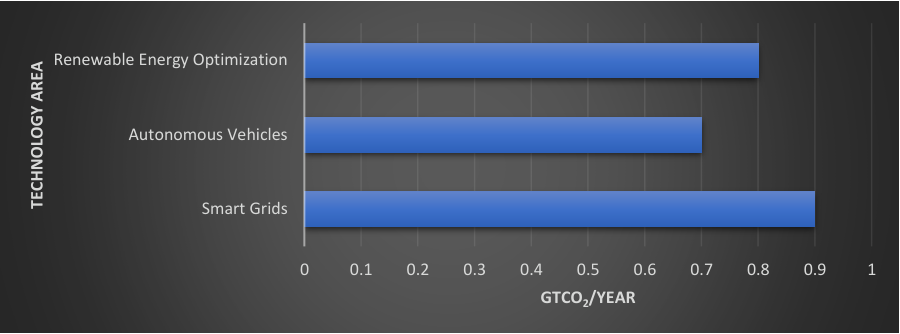
CO₂ Emission Reduction Potential with AI-Driven Technologies
AI technologies could contribute to reducing global CO₂ emissions by up to 10%, showcasing their transformative potential in the fight against climate change. [5]
2.2 Resource Optimization and Waste Management
AI systems optimize the use of natural resources and improve waste management strategies:
- Water Management: AI monitors and predicts water usage patterns, reducing wastage. For instance, IBM's AI tools saved 700 billion gallons of water globally. [6]
- Smart Recycling: Image recognition and robotics powered by AI enhance sorting accuracy in recycling facilities.
- Case Study: The city of Seoul uses AI-powered waste sorting systems, achieving over 95% recycling efficiency for plastics. [7]
2.3 Biodiversity and Ecosystem Monitoring
Conservation efforts are greatly enhanced by AI:
- Wildlife Monitoring: AI-driven drones and camera traps track animal populations and prevent poaching.
- Habitat Analysis: Machine learning identifies and predicts threats to critical habitats.
- Case Study: Microsoft’s AI for Earth initiative has mapped 10% of Earth's land cover, aiding biodiversity conservation. [8]
- AI tools like TensorFlow and PyTorch are increasingly being adapted for conservation purposes, offering scalable and efficient solutions.
3. Challenges and Ethical Concerns
Despite its potential, AI faces challenges in environmental applications:
- Data Limitations: Incomplete or biased datasets can lead to inaccurate predictions and flawed solutions.
- Energy Consumption: Training AI models requires significant computational resources, paradoxically increasing carbon emissions. Green AI initiatives focus on addressing this paradox by designing energy-efficient AI models.
- Ethical Concerns: Balancing technological advancements with local ecological and social impacts is a persistent challenge. For instance, deploying AI systems in developing regions must consider equitable access and cultural sensitivity.
4. The Future of AI in Sustainability
AI's capabilities are expected to grow with advancements in quantum computing and IoT integration. Future applications include precision agriculture, enhanced carbon capture methods, and AI-driven urban planning to create smart, sustainable cities.
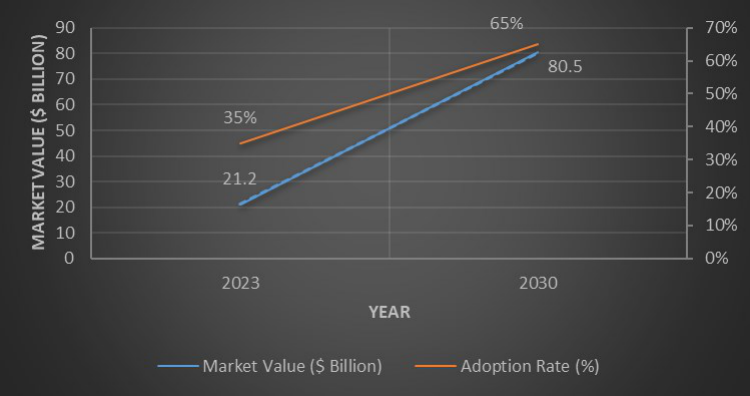
According to Allied Market Research (2023), the green AI market is projected to grow at a CAGR of 25% over the next decade, underscoring its importance in achieving sustainability goals. [9]
5. Conclusion
AI is a powerful tool for driving environmental sustainability, offering innovative solutions to some of the world's most pressing ecological challenges. However, collaboration across industries, policymakers, and environmental groups is essential to harness AI’s potential responsibly. By integrating AI into global efforts aligned with the UN's Sustainable Development Goals (SDGs), we can create a harmonious balance between technology and the environment. Addressing ethical concerns and reducing AI’s environmental footprint are key steps in ensuring its role as a force for good.
6. References
[3] Google, "Google," [Online]. Available: (DeepMind AI reduces energy used for cooling Google data centers by 40%).
[4] Tesla, "Tesla," [Online]. Available: Best Tesla Powerwall in 2024: Here.
[5] BCG, [Online]. Available: https://www.bcg.com/publications/2023/how-ai-can-speedup-climate-action?utm.
[6] IBM, [Online]. Available: https://newsroom.ibm.com/2023-03-14-IBM-launches-RFP-to-help-accelerate-global-water-management-solutions-for-vulnerable-populations?utm.
[7] Seoul. [Online]. Available: https://english.seoul.go.kr/seoul-to-increase-recycling-rate-to-79-by-2026/?utm.
[8] Microsoft. [Online]. Available: https://news.microsoft.com/apac/2021/10/11/microsoft-ai-for-earth-named-as-one-of-100-outstanding-biodiversity-positive-practices-and-actions-around-the-world/#:~:text=Launched%20in%202017%2C%20Microsoft%E2%80%99s%20%E2%80%9CAI%20for%2 0Earth%E2%80%9D%20is.
[9] A. M. Research. [Online]. Available: Artificial Intelligence (AI) Market Size, Share, Trends – 2033).
Related Content
Sudan's Energy Balance 2020
Sudan’s energy balance for the year 2020 had shown lower figures from previous years trends, while maintaining largely the same proportions of energy supply resources,
Read Article →Scope 4 Emissions: The Concept of Avoided Emissions
In the global effort to combat climate change, the focus has traditionally been on reducing greenhouse gas (GHG) emissions from corporate operations and value chains.
Read Article →DPSIR Framework for Sustainable Aquaculture in the Red Sea Region (KSA): A Climate Adaptation and Mitigation Perspective
This paper is a contribution to the 6th International Workshop on Applied Research for Enhancing the Aquaculture Sector in Saudi Arabia.
Read Article →