

Understanding the DPSIR, DPCER, DPSWR, and DPSER Frameworks in analyzing the interactions between human activities and the environment
Understanding the DPSIR, DPCER, DPSWR, and DPSER Frameworks in analyzing the interactions between human activities and the environment
Read the original archive edition (PDF)
Environmental challenges such as climate change, pollution, and biodiversity loss require comprehensive frameworks for analysis and management. The International Environmental Assessment and Strategy Centre (IEASC), which is a research institute associated with the United Nations Environment Programme (UNEP) develop framework called DPSIR in the late 1990s and has since become a widely used tool in environmental assessment and policy analysis The DPSIR framework provides a structured approach to understanding the causal relationship between human activities and environmental impacts. This article discusses the original DPSIR framework and its derivatives — DPCER, DPSWR, and DPSER— highlighting their unique features and applications.
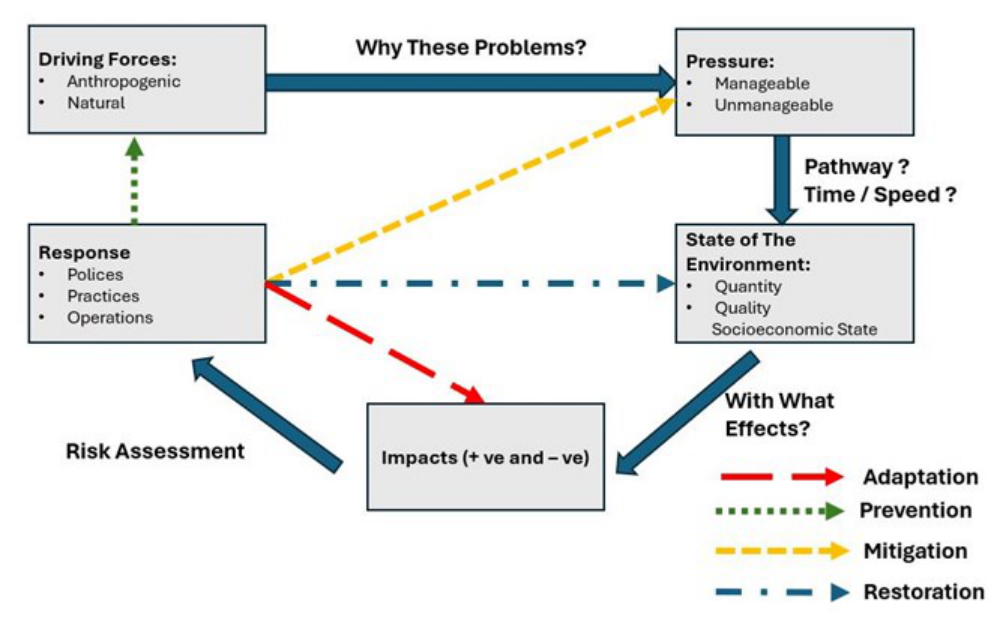
Overview of the Frameworks
1. DPSIR Framework
The DPSIR framework consists of five components:
- Drivers: Socio-economic factors that lead to environmental changes.
- Pressures: Human activities that exert stress on the environment.
- State: The condition of the environment resulting from pressures.
- Impact: The effects of changes in the state on ecosystems and human health.
- Response: Actions taken to mitigate or adapt to environmental issues.
2. DPCER Framework
The DPCER framework focuses specifically on chemical pollution:
- Drivers: Socio-economic activities leading to chemical emissions.
- Pressures: Release of chemicals into the environment.
- Chemical State: Concentrations of chemicals in various media.
- Ecological State: Effects of chemical pollution on ecosystems.
- Response: Measures to control or mitigate chemical pollution.
3. DPSWR Framework
The DPSWR framework emphasizes human welfare:
- Drivers: Socio-economic factors influencing environmental change.
- Pressures: Activities that exert pressure on the environment.
- State: Environmental conditions resulting from pressures.
- Welfare: Impacts on human well-being and quality of life.
- Response: Actions taken to address impacts on welfare.
4. DPSER Framework
The DPSER framework highlights ecosystem services:
- Drivers: Human activities leading to environmental changes.
- Pressures: Actions that cause stress on ecosystems.
- State: Condition of the environment and its services.
- Ecosystem Services: Benefits provided by ecosystems to humans.
- Response: Strategies to maintain or restore ecosystem services.
Uses of the Frameworks
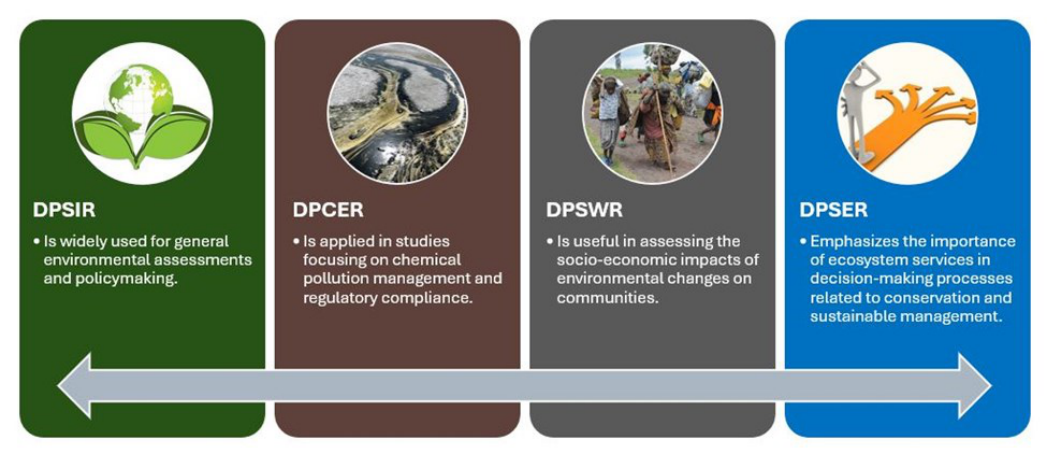
Each framework serves distinct purposes as shown below:
Differences Between the Frameworks
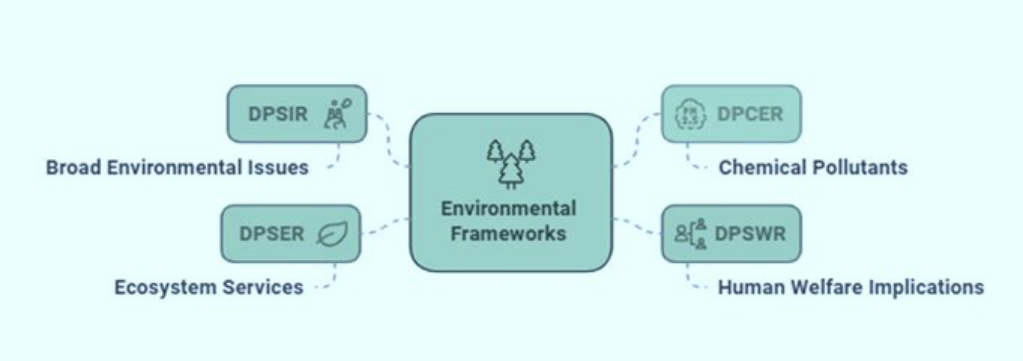
While all four frameworks share a common structure based on causal relationships, they differ in focus:
- DPSIR addresses a broad range of environmental issues without emphasizing specific aspects like chemicals or welfare.
- DPCER narrows down on chemical pollutants and their ecological impacts.
- DPSWR shifts attention to human welfare implications rather than purely ecological factors.
- DPSER integrates ecosystem services into the analysis, highlighting their role in human well-being.
Interrelationship Among the Frameworks
The frameworks are interconnected:
- The DPSIR framework serves as a foundation for both DPCER and DPSWR by providing a general structure for analysis.
- DPCER can be seen as a specialized application of DPSIR focused on chemical impacts, while DPSWR extends the discussion to human welfare outcomes.
- Similarly, DPSER builds upon DPSIR by incorporating ecosystem services into its analysis, reflecting the growing recognition of their importance in sustainability discussions.
Summary:
The DPSIR, DPCER, DPSWR, and DPSER frameworks provide valuable tools for understanding complex environmental issues. By recognizing their differences and interrelations, policymakers and researchers can choose appropriate frameworks for specific contexts, ultimately enhancing efforts toward sustainable development.
References
- Gari et al. (2016). "DPSIR— Two Decades of Trying to Develop a Unifying Framework for Marine Environmental Management." Frontiers in Marine Science.
- Allen, W. (2022). "Extending the DPSIR Framework." i2Insights.
- GRID-Arendal (2005). "The DPSIR Framework."
- US EPA (n.d.). "Systems Thinking Tutorials: Module 2: DPSIR Overview."
- Antonescu, Ralu (2018). "Applying DPSIR Model to Sustainable Territorial Development." Journal of Urban and Landscape Planning.
- Environmental Systems Research (2022). "Application of DPSIR Model to Identify Drivers and Impacts."
- FAO (n.d.). "Driver-Pressure-State-Impact Response Framework."
Related Content
Sudan's Energy Balance 2020
Sudan’s energy balance for the year 2020 had shown lower figures from previous years trends, while maintaining largely the same proportions of energy supply resources,
Read Article →Scope 4 Emissions: The Concept of Avoided Emissions
In the global effort to combat climate change, the focus has traditionally been on reducing greenhouse gas (GHG) emissions from corporate operations and value chains.
Read Article →The Imperative for ESG Readiness Tools: Unlocking Benefits for Companies, Institutions, and Society
Environmental, Social, and Governance (ESG) considerations have evolved from being a corporate trend to becoming essential criteria for sustainable and ethical growth.
Read Article →