

The Hidden Link Between Cigarette Smoking and Climate Change
The Hidden Link Between Cigarette Smoking and Climate Change
Read the original archive edition (PDF)
When we think about climate change, the usual suspects that come to mind are industries, automobiles, and deforestation. However, there is an often-overlooked contributor to environmental degradation and climate change: cigarette smoking. While smoking is primarily recognized for its health impacts, its environmental footprint is significant and alarming.
Cigarette Production and Deforestation
The journey of a cigarette begins with tobacco farming, a process that heavily relies on deforestation. Vast areas of forests are cleared to make way for tobacco plantations. According to the World Health Organization (WHO), tobacco farming is responsible for the loss of 200,000 hectares of forests each year. These forests, which act as carbon sinks, are vital in absorbing CO2 from the atmosphere. When they are destroyed, the carbon stored in trees is released back into the atmosphere, contributing to global warming.
Carbon Emissions from Tobacco Manufacturing
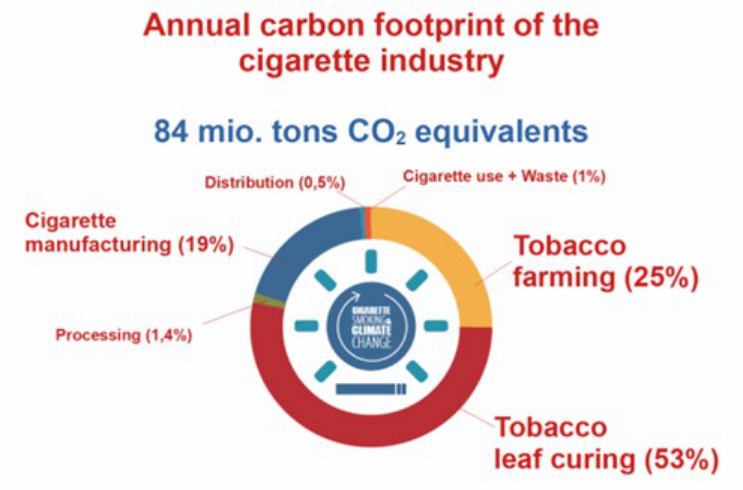
The manufacturing process of cigarettes is another significant source of carbon emissions. It’s estimated that the production of just 300 cigarettes (around 15 packs) results in the emission of about 1 kilogram of CO2. With nearly 6 trillion cigarettes produced annually worldwide, the carbon footprint is staggering.
Moreover, the energy consumption involved in curing tobacco, manufacturing cigarettes, and packaging is considerable. Factories rely on fossil fuels for energy, further increasing the carbon emissions associated with cigarette production.
Environmental Impact of Cigarette Waste
Cigarette butts are the most discarded waste item worldwide, with about 4.5 trillion butts littered each year. These butts are not just unsightly; they are also toxic. They leach harmful chemicals, such as nicotine, heavy metals, and carcinogens, into the soil and waterways, harming wildlife and ecosystems.
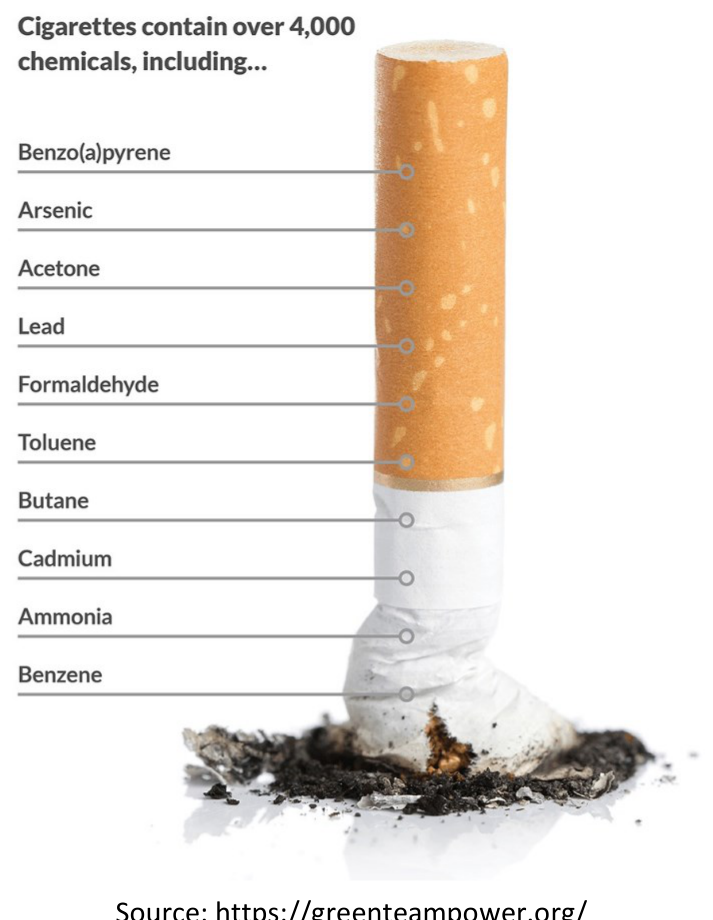
But beyond the direct pollution, the decomposition of cigarette butt’s releases greenhouse gases. Though each individual butt contributes a small amount, the cumulative impact of trillions of discarded butts is significant.
Fires Caused by Smoking
Another link between smoking and climate change is the role of cigarettes in starting wildfires. Carelessly discarded cigarette butts are a common cause of forest fires, which can result in the loss of vast areas of forest and significant carbon emissions. Wildfires not only release carbon stored in trees but also reduce the planet’s capacity to absorb CO2, creating a vicious cycle.
The Bigger Picture
While smoking is often framed as a personal choice with personal health consequences, it is also an environmental issue with global implications. The entire lifecycle of a cigarette — from production to disposal — contributes to climate change. Reducing smoking rates worldwide could have a meaningful impact not only on public health but also on the health of our planet.
This intersection between personal behavior and global climate change highlights the importance of addressing all contributors to environmental degradation, no matter how seemingly small. By raising awareness of the environmental impacts of smoking, we can encourage more people to quit, benefiting both their health and the planet.
References
- World Health Organization (WHO), 2017. Tobacco and its Environmental Impact: An Overview. Available at: https://www.who.int/publications/tobacco-and-environment [Accessed 28 November 2024].
- Unfairtobacco.org, 2024. Tobacco Harms the Environment and Climate. Available at: https://unfairtobacco.org/en/tobacco-harms-environment-climate [Accessed 28 November 2024].
- Novotny, T. E. and Zhao, F., 1999. Consumption and Production Waste: Another Externality of Tobacco Use. Tobacco Control, [online] 8(1), pp. 75-80. Available at: https://tobaccocontrol.bmj.com/content/8/1/75 [Accessed 28 November 2024].
- Truth Initiative, 2021. The Environmental Impact of Cigarette Smoking. Available at: https://truthinitiative.org/research-resources/environment/environmental-impact-cigarette-smoking [Accessed 28 November 2024].
- Novotny, T. E. et al., 2021. The Environmental and Health Impacts of Cigarette Waste. International Journal of Environmental Research and Public Health, 18(6), p. 3243. Available at: https://doi.org/10.3390/ijerph18063243 [Accessed 28 November 2024].
- Campaign for Tobacco -Free Kids, 2020. Tobacco’s Hidden Environmental Costs. Available at: https://www.tobaccofreekids.org/assets/factsheets/0385.pdf [Accessed 28 November 2024].
- Healton, C. G., 2022. Cigarette Smoking and its Role in Forest Fires. Environmental Hazards Review, 14(3), pp. 110-115. Available at: https://doi.org/10.1080/1223456 [Accessed 28 November 2024].
- Proctor, R. N., 2011. Golden Holocaust: Origins of the Cigarette Catastrophe and the Case for Abolition. University of California Press. [Covers tobacco's extensive environmental and societal harms].
Related Content
Scope 4 Emissions: The Concept of Avoided Emissions
In the global effort to combat climate change, the focus has traditionally been on reducing greenhouse gas (GHG) emissions from corporate operations and value chains.
Read Article →The Imperative for ESG Readiness Tools: Unlocking Benefits for Companies, Institutions, and Society
Environmental, Social, and Governance (ESG) considerations have evolved from being a corporate trend to becoming essential criteria for sustainable and ethical growth.
Read Article →DPSIR Framework for Sustainable Aquaculture in the Red Sea Region (KSA): A Climate Adaptation and Mitigation Perspective
This paper is a contribution to the 6th International Workshop on Applied Research for Enhancing the Aquaculture Sector in Saudi Arabia.
Read Article →